
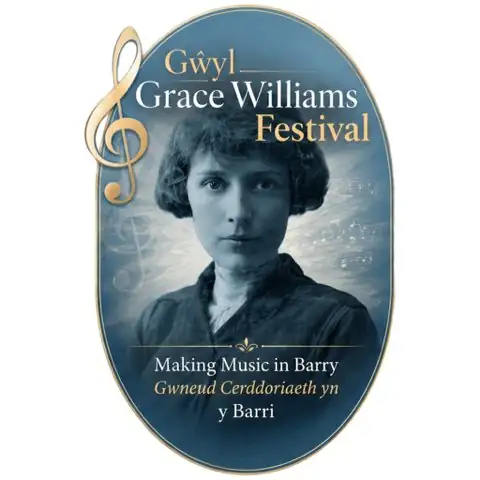
She studied with Vaughan Williams, turned down the chance to work alongside Britten and wrote the first British feature film score by a woman. Fifty years after her death, Grace Williams is finally getting a festival in the town that shaped her music.
Put on Sea Sketches and within a few bars you can hear the Bristol Channel. The wind gets up, the strings whip and swirl, and then everything falls still. Grace Williams wrote it in 1944, a long way from home, and dedicated it to her parents, who, as she put it, “had the good sense to set up home on the coast of Glamorgan.”
That coast was Barry. In February 2027, fifty years after her death, the town is celebrating its most gifted composer with the Grace Williams Festival, a month of concerts, songs, film and history walks.
From the Romilly Boys’ Choir to Vienna
Grace was born in Barry in 1906 into a house full of music. Her father, a teacher, conducted the Romilly Boys’ Choir, and at school her music teacher, Rhyda Jones, pushed her to compose. She went on to study in Cardiff, then at the Royal College of Music under Ralph Vaughan Williams, where her fellow students included Elizabeth Maconchy. Benjamin Britten became a close friend and a great encourager of her work. A scholarship then took her to Vienna to study with Egon Wellesz.
Britten thought enough of her to offer her a job as his assistant. She said no, and chose to go her own way.
The sound of the sea
Sea Sketches is the perfect way in. Its five movements, High Wind, Sailing Song, Channel Sirens, Breakers and Calm Sea in Summer, are written for strings alone, and it was first performed by the BBC Welsh Orchestra under Mansel Thomas in March 1947. It is often described as the moment she found her own voice.
The sea never really left her music. Her unaccompanied choral setting of Ave Maris Stella, from 1973, rises and falls like a swell, and plenty of listeners hear the same tides running through her orchestral writing.
Welsh roots, modern ears
Wales has always been a land of choirs, but Grace was above all an orchestral composer. She drew on her own heritage in pieces like the Fantasia on Welsh Nursery Tunes, still one of her best-loved works, and Penillion, written in 1955 for the National Youth Orchestra of Wales. Penillion takes its name from the old Welsh tradition of singing verses over a harp melody, and it remains one of her most popular pieces. She reworked some of its ideas in her Trumpet Concerto of 1963.
Her Ballads for Orchestra were written for the 1968 National Eisteddfod, held that year in her home town, and her biggest work, Missa Cambrensis, is a Welsh mass for soloists, choirs, narrator and large orchestra that runs for more than an hour.
A first for film, and an opera
In 1949 Grace scored Blue Scar, Jill Craigie’s drama set in a south Wales mining community, becoming the first British woman to write the music for a feature film. Her one-act opera The Parlour, based on a Guy de Maupassant story, reached the stage in 1966.
She was famously self-critical, destroying early manuscripts she felt were not good enough to keep, and she turned down an OBE in 1967. She died in Barry in February 1977, aged 70.
A revival on record
For years her music was hard to find, but that is changing. A 2024 album gathered 29 of her songs in premiere recordings, and in 2025 Missa Cambrensis finally got its first commercial recording, from the BBC National Orchestra and Chorus of Wales.
The festival programme
The highlight for many will be the gala concert on Saturday 13 February, when the Welsh baritone Jeremy Huw Williams, born just down the road in Dinas Powys, sings a programme of Grace’s songs at All Saints’ Church, Barry. Earlier the same afternoon, Tea with Grace and Friends brings musicians from the Royal Welsh College of Music & Drama to the same venue.
Other classical dates include Returning Home: Songs by Grace Williams, with Helen Jarmany and Stacey Wheeler, on 6 February; the Welsh piano duo Sonant, Sian James and Sioned Webb, at Barry Town Hall on 19 February; a Barry Community Orchestra family concert on 21 February; and the City of Cardiff Symphony Orchestra at All Saints’ Church on 27 February.
Blue Scar is screened at Ysgol St Baruc on 7 February, so you can hear that film score as it was meant to be heard, and the documentary Grace Williams: an Enduring Fight is shown once, on 10 February.
The festival also celebrates music in Barry today, with gigs from Cole Stacey, Me + Him, Matt Blumberg, the Danielle Nicholls Band, Acoustic Divas and Claire Victoria Roberts in bars and venues around the town, plus history walks through the month, including one in Welsh.
What
Grace Williams Festival (Gŵyl Grace Williams)
Where
Venues across Barry, Vale of Glamorgan
When
5 to 28 February 2027
More information and tickets
gracewilliamsfestival.com
Music Life Tip!
Listen to Sea Sketches before you go, then take a walk along the seafront at Barry Island or the Knap. You will hear exactly where it came from.
…
Grace’s Barry story
For more on the town she grew up in and came home to, head over to our sister title. Read it on Vale Life.
…


